
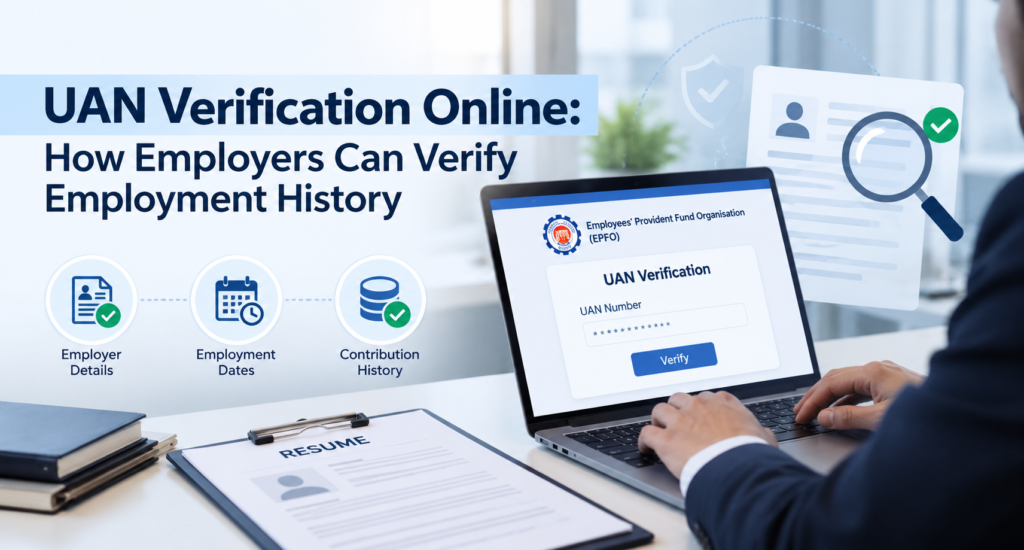
Quick answer:
Employers can use an authorised UAN verification process to compare available EPFO-linked records with a candidate’s resume and documents. This may help check recorded employers, contribution activity, and employment dates. It does not prove a candidate’s complete work history, job title, salary, or performance on its own.
Hiring teams often face a simple problem: the information on a candidate’s resume does not always match the documents received during screening. A joining date may be different. An employer may be missing from the declaration. A job title may be broader on the resume than it was in the company’s records.
That is where UAN verification online can be useful. It gives employers another source to compare with the information provided by a candidate. It is not a replacement for a complete background verification process, but it can help HR teams decide where a closer check is needed.
What is UAN verification?
UAN stands for Universal Account Number. It is linked to an EPFO member’s provident fund services. The official EPFO portal provides services such as UAN activation, passbook access, KYC updates, and online claims.
In employment verification, available EPFO-linked records may help an employer review an establishment associated with a candidate, contribution activity, and some employment-related dates. The exact information depends on the records available and the authorised method used for the check.
A UAN is not a complete employment file. It does not automatically prove every job a person has held, and it does not confirm performance, responsibilities, salary, or reason for leaving. Employers should treat it as one piece of evidence within a wider background check.
How can employers verify employment history using UAN?
1. Decide what needs to be verified
Start with the business reason for the check. Are you checking a previous employer? Reviewing a gap in the resume? Comparing employment dates? Or deciding whether a direct employer check is necessary?
A clear purpose keeps the process focused and avoids collecting information that is not needed.
2. Explain the process to the candidate
Tell the candidate what will be checked and why. Obtain the appropriate consent or authorisation for the verification route you intend to use.
A candidate’s UAN should not be treated as permission to access everything connected to the account. Do not ask the candidate for an EPFO password or one-time password.
3. Use an authorised verification route
The result depends on the account status, the records linked to the UAN, the service being used, and the permissions in place. Employers should not try to bypass EPFO controls or use informal access methods.
4. Compare the record with supporting documents
Review the candidate’s resume, application form, experience letter, relieving letter, salary documents, and declaration. Compare employer names, dates, and other details that matter to the role.
The goal is not to find a reason to reject someone. It is to understand whether the information is consistent and, where it is not, what explains the difference.
5. Investigate any mismatch
Ask the candidate for clarification before reaching a conclusion. Differences can arise because of payroll cut-off dates, transfers between group companies, staffing arrangements, data-entry errors, or delayed updates.
If the question remains important, contact the previous employer or request another supporting document.
| Stage | Purpose |
| Define the scope | Decide what information matters |
| Obtain authorisation | Give the candidate notice and use a permitted process |
| Review records | Examine available EPFO-linked information |
| Compare documents | Check the candidate’s claims against supporting evidence |
| Resolve differences | Clarify issues before making a decision |
What information can UAN verification show?
Where the relevant records are available, UAN verification may support a review of the following:
| Information | What it may help establish |
| Employer or establishment details | A recorded association with an organisation |
| Contribution activity | Provident fund contributions recorded during a period |
| Employment-related dates | Supporting evidence for dates in the available record |
| Difference from the resume | A point that needs clarification |
| Job title and responsibilities | Usually require employer or document confirmation |
| Salary | Usually requires salary documents or employer confirmation |
| Complete employment history | Cannot be guaranteed from UAN records alone |
An apparent overlap in contribution periods may need further investigation. It should not automatically be described as fraud, dual employment, or misconduct. The employer needs to understand the circumstances first.
Why is UAN employment verification useful?
UAN employment verification gives HR teams an additional reference point. It may help identify an employment period that was not included in the candidate’s declaration, bring attention to a date difference, or show that a direct employer check would be useful.
It can also make a background verification process more structured. Instead of relying only on a resume or waiting for a former employer to reply, the HR team can compare several sources before making a decision.
The check is most useful when it complements, rather than replaces, traditional employment verification.
What are the limitations of online UAN verification?
It may not show every job
A missing entry does not automatically prove that the candidate never worked for an organisation. Record availability can be affected by reporting practices, eligibility, employment structure, account status, or individual circumstances.
Some work may not appear
Overseas employment and work outside the relevant EPFO-covered arrangements may not be visible in the available records. A gap therefore needs context before it is treated as a concern.
It does not confirm job title or salary
UAN-related records do not, by themselves, confirm a candidate’s designation, daily responsibilities, performance, salary, reporting manager, or reason for leaving. Those details usually require documents or confirmation from the previous employer.
Dates can differ between records
A payroll date, HR date, relieving date, and candidate-declared date may not be identical. Notice periods, internal transfers, and administrative errors are common reasons for differences. Give the candidate a fair opportunity to explain.
Privacy and access are important
UAN-linked information is personal information. Employers should use a genuine business purpose, follow an authorised process, restrict access to relevant staff, protect reports, and apply their privacy and retention policies. EPFO provides secure member services through its official platforms.
| Issue | Appropriate HR response |
| Missing record | Request additional supporting documents |
| Date difference | Compare sources and ask for clarification |
| Unconfirmed job title | Contact the previous employer |
| Incomplete history | Add relevant employment checks |
| Restricted access | Use an authorised verification process |
UAN verification and direct employment verification
These checks answer different questions.
| UAN-based verification | Direct employment verification |
| Uses available EPFO-related records | Uses previous-employer confirmation and documents |
| May support employer and date checks | Can confirm title, salary, responsibilities, and separation details |
| Depends on record availability and access | Depends on employer response and evidence |
| Best used as supporting evidence | Best used when a specific job detail must be confirmed |
For a senior, regulated, or client-facing role, one source may not be enough. Combining UAN-related information with direct employment verification gives the HR team a more complete basis for review.
Best practices for employers
•Explain the purpose of the background verification before collecting information.
•Obtain appropriate consent or authorisation.
•Never request EPFO passwords or OTPs.
•Compare UAN-related information with the candidate’s documents.
•Treat discrepancies as questions to investigate, not automatic proof of fraud.
•Contact previous employers when title, salary, responsibilities, or separation details matter.
•Keep reports secure and limit access to authorised staff.
•Record the sources reviewed and the reason for the final decision.
Frequently asked questions
What is UAN verification online?
It is the authorised review of available EPFO-linked information connected with a candidate’s UAN. Employers may use it to support checks of recorded employers, contribution activity, and employment-related dates.
Can employers verify employment history using UAN?
Yes, they may use available UAN-related information as one source of evidence. The result should be compared with candidate documents and, where needed, confirmation from previous employers.
Does UAN verification show complete employment history?
No. Record gaps, reporting issues, overseas employment, non-covered work, and access limitations can affect the result. It should not be marketed as a guaranteed complete work-history report.
Can UAN verification confirm a job title or salary?
Usually not. Job title, responsibilities, salary, reporting manager, and reason for leaving generally require documents or confirmation from the previous employer.
Is UAN verification enough for a background check?
No. It is one part of an employee background check. Depending on the role, employers may also need identity, education, address, criminal-record, reference, or licence checks.
What should HR do if UAN records do not match documents?
Ask the candidate for an explanation and supporting evidence. If the difference remains significant, contact the previous employer or conduct another relevant check before making a decision.
Is candidate consent needed for UAN verification?
Employers should use the appropriate consent or authorisation process and explain what will be checked. They should never request the candidate’s EPFO password or OTP.
Conclusion
UAN verification online can help employers cross-check available EPFO-linked employment information. It may support checks of employer associations, contribution activity, and dates, but it cannot prove a complete work history or every job detail. The strongest employment verification process combines authorised UAN review with document comparison and direct employer confirmation when necessary.